
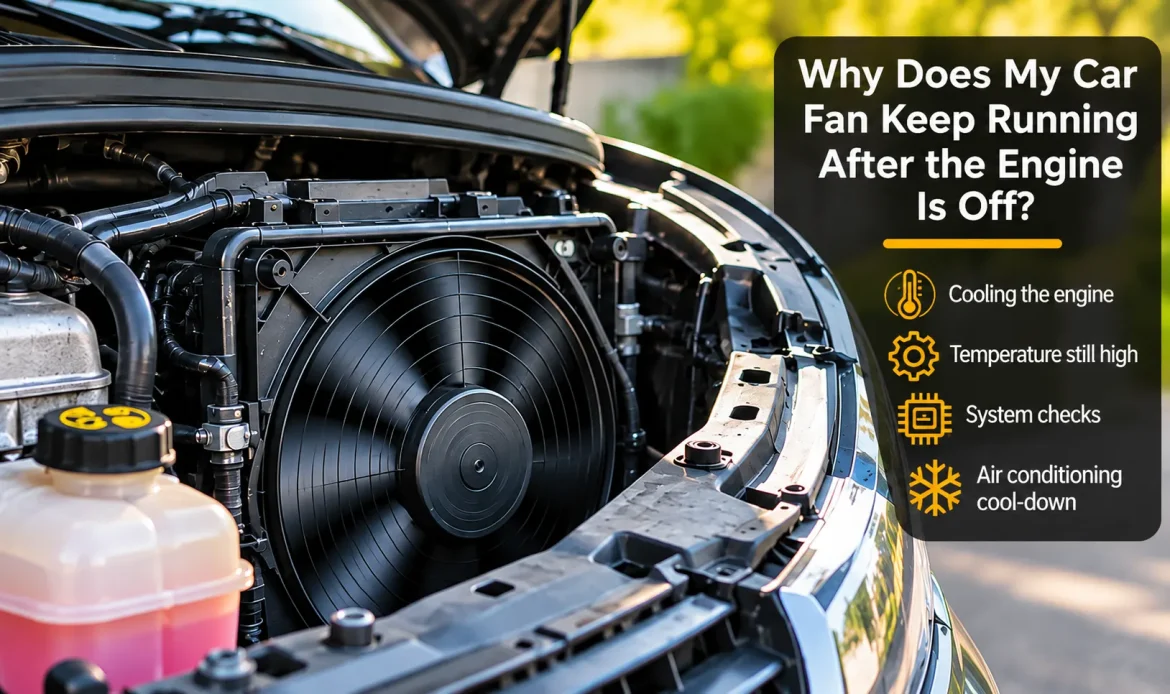
A car fan keeps running after the engine is off when the cooling system is removing retained heat, the air-conditioning system has raised the under-bonnet temperature, or a diesel particulate filter regeneration has recently been active. A short, controlled run with no warning lights can therefore be normal on some European cars. It needs investigation when the fan runs for an unusually long time, starts from a cold engine, returns after every short trip, flattens the battery, accompanies a temperature warning, or appears with coolant loss, steam, poor performance or a warning light.
Do not open the coolant reservoir while the engine is hot. If the temperature warning is red, steam is present or coolant is pouring out, stop safely, switch the engine off and arrange assistance rather than continuing to drive.
If your car fan keeps running after the engine is off, it can sound as though the vehicle has failed to switch off. Sometimes the system is doing exactly what it was designed to do. Sometimes it is the first useful clue that a sensor, relay, cooling component or emissions process needs attention.
We will first separate normal after-run behaviour from warning signs. Then we will explain the main causes, the checks you can make without touching a hot engine and how we diagnose a radiator fan that stays on at our Croydon workshop.
Why can a car fan keep running after the engine is off?
Switching off stops combustion, but heat remains in the engine, turbocharger, coolant and exhaust. With no airflow from driving, temperature can briefly rise in particular areas. Some vehicles keep an electric fan or auxiliary pump operating to manage that heat.
The engine-control unit decides when the fan runs using temperature, air-conditioning demand and other inputs. The exact strategy differs by engine and model. That is why “mine never did this before” is useful information, but not proof of failure by itself.
The fan should still behave in a controlled way. A car fan that keeps running after the engine is off for a short period after a hot drive is different from one that runs from cold, continues for a very long time or repeatedly drains the battery.
When is post-shutdown fan operation usually normal?
Normal operation is more likely when:
- The weather is hot;
- The air conditioning was working hard;
- The car has just climbed hills or sat in slow traffic;
- The engine was under sustained load;
- The fan stops by itself after a short period;
- The temperature gauge remained normal; and
- There is no coolant smell, leak, steam or warning message.
The owner’s manual may mention fan operation after shutdown and should be checked for the specific vehicle. Volkswagen’s Australian owner’s resources, for example, direct owners to vehicle-specific manual information rather than a universal operating time.
Do not stand close to an electric fan or reach into the engine bay because the engine is off. Electric cooling fans can start automatically.
Which signs suggest the fan needs diagnosis?
The pattern around the noise is more useful than the noise alone.
| What happens | What it may indicate | What to do |
| Fan stops after a short hot-weather run | Normal heat management may be occurring | Monitor for changes or warnings |
| Fan runs after almost every short trip | Temperature input, cooling or regeneration issue may need checking | Book diagnosis |
| Fan starts when the engine is cold | Sensor, wiring, relay or control fault is possible | Arrange testing |
| Fan continues until the battery is flat | Electrical control fault or abnormal demand | Avoid repeated jump-starts and book auto-electrical diagnosis |
| Temperature warning, steam or coolant loss | Cooling system may be overheating or leaking | Stop safely and arrange assistance |
| Fan with DPF light, high idle or hot smell on a diesel | An active regeneration may have been interrupted | Follow the manual and arrange diagnosis if it repeats |
Call Arnpro on (03) 9839 8920 promptly if a temperature warning appears. Do not keep driving to see whether it clears.
Common reasons a radiator fan stays on
Once we know the circumstances, we can place the likely causes into a few groups.
- The engine is shedding retained heat
This is the ordinary explanation after a demanding drive or hot day. Turbocharged engines can retain considerable heat after stopping. A fan or coolant pump may continue briefly to move heat away from sensitive components.
The behaviour should be consistent with the drive and should stop automatically. A sudden change in duration or frequency still deserves attention, especially if coolant level is falling.
- The air-conditioning system has increased cooling demand
The air-conditioning condenser sits at the front of the vehicle and needs airflow to release heat. A fan may run more often during hot weather or after heavy air-conditioning use.
If the cabin air is warm, fan operation is unusually loud, or the compressor cycles strangely, the cooling and air-conditioning systems may need to be assessed together. Replacing refrigerant without checking pressures, sensors, and fan control can miss the actual fault.
- A diesel particulate filter regeneration was active
Many European diesels periodically raise exhaust temperature to burn soot from the diesel particulate filter, or DPF. During an active regeneration, you may notice a higher idle, hot smell, increased fuel use or a fan that continues after parking.
One interrupted event does not prove the DPF is blocked. Repeated short trips can, however, prevent regeneration from completing. Our existing guide explains DPF problems in European diesels and why stop-start Melbourne driving affects the process.
Do not park a very hot vehicle over dry grass or combustible material. Exhaust components can reach high temperatures during regeneration.
- A coolant-temperature sensor is reporting incorrectly
The control unit depends on temperature sensors. If a sensor or its circuit reports an implausibly high temperature, the system may run the fan as a protective response.
A dashboard gauge can still appear normal on some faults. Diagnosis involves comparing temperature readings when the engine is cold and warm, checking whether values agree, and inspecting the circuit rather than simply replacing the sensor named in a code.
- A fan relay or control module is stuck
Some vehicles use a relay, fan-control module or electronically controlled fan assembly. A stuck contact or failed module can keep power flowing after the control unit has stopped requesting the fan.
This may create an intermittent flat battery. The battery is then blamed because it is discharged, even though the fan-control fault caused the discharge. Testing current draw and commanded fan status helps separate cause from consequence.
- The cooling system is genuinely running too hot
Low coolant, a leak, a restricted radiator, a faulty thermostat, a weak water pump or air trapped after repair can raise temperature. The fan may be trying to compensate for a problem it cannot solve.
Our European car coolant guide explains why correct coolant specification matters. Mixing products by colour alone is unreliable because colour is not a universal technical standard.
- Software or network information is incorrect
A control-module software issue or loss of communication can cause a protective fan strategy. This is less visible than a leaking hose, but it still leaves evidence in vehicle-specific fault data.
The presence of an electronic code does not automatically mean a module needs replacement. Power supply, earth and network wiring need to be checked first.
What can you safely check at home?
You can gather useful information without opening a hot cooling system:
1. Note how long the fan runs and whether the engine was hot or cold.
2. Photograph any dashboard warning before switching off.
3. Watch the temperature gauge while driving, without becoming distracted.
4. Look under the parked car for fresh liquid once it is safe.
5. Smell from a distance for a sweet coolant odour or an electrical burning smell.
6. Check the coolant level only when the engine is completely cold and follow the manual.
7. Record whether air conditioning or a diesel regeneration appeared active.
Never remove a pressurised coolant cap from a hot engine. The Queensland Government’s vehicle-maintenance advice warns drivers to take care around hot engines and maintain fluid levels according to manufacturer guidance. Hot coolant can escape under pressure and cause serious burns.
Do not pull a fuse at random to silence the fan. You may disable necessary cooling and remove evidence needed for diagnosis.
Why can the battery go flat when the car fan keeps running after the engine is off?
A correctly controlled after-run period should be considered in the vehicle’s electrical design. If the fan continues far longer than intended, a healthy battery can still discharge. A weak battery may make the outcome happen sooner, but replacing it without addressing the fan demand sets up the same failure again.
We may check:
- battery state of health and state of charge;
- alternator output and voltage stability;
- fan current draw;
- whether the control unit is commanding the fan;
- relay or fan-module operation; and
- vehicle sleep current after modules should have shut down.
That last measurement is important on modern European vehicles. A car can remain awake because a module, accessory or network fault prevents the normal sleep state.
How we diagnose a fan that keeps running
We begin with the symptom pattern and the identified vehicle, not a generic list. A useful process includes:
| Diagnostic step | What it helps establish |
| Cold and warm scan data | Whether temperature values are plausible |
| Cooling-system inspection | Whether coolant loss, leakage or flow issues are present |
| Fan command test | Whether the fan responds correctly at different requested speeds |
| Circuit testing | Whether power, earth, relay and control signals are sound |
| Pressure or temperature checks | Whether the engine is actually running hotter than expected |
| DPF data on a diesel | Whether regeneration and soot loading explain the pattern |
| Sleep-current test | Whether the fan or another circuit is draining the battery |
Our diagnostic and fault-finding service combines scan information with electrical and mechanical testing. We do not replace a sensor just because its name appears in a code.
Can you drive to the workshop?
You may be able to drive a short distance if the fan has stopped, coolant is at the correct cold level, the temperature remains normal, no red warning is present, and the car operates normally. Even then, call first if you are uncertain.
Do not drive when:
- A red temperature or coolant warning is showing;
- Steam is coming from the engine bay;
- Coolant is leaking rapidly;
- The engine runs roughly or loses significant power;
- The fan has already flattened the battery repeatedly; or
- A strong electrical burning smell is present.
Towing is less costly than turning an accessible cooling fault into an overheated engine.
How servicing helps prevent cooling problems?
Scheduled servicing includes checks that may reveal a deteriorating hose, low coolant or stored warning before the driver sees an obvious failure. It also allows the correct coolant and repair procedures to be used.
That does not mean every fan fault is preventable. Relays and electronics can fail without a service item being overdue. The value of maintenance is having a baseline, a record and an opportunity to find changes early.
Our repair and maintenance service in Croydon covers cooling and auto-electrical faults within Arnpro’s service scope. If something can wait, we will tell you. If driving risks further damage, we will explain why.
Book a cooling-fan diagnostic in Croydon
If your car fan keeps running after the engine is off and the pattern has changed, note the timing and call us. Arnpro Automotive is a family-owned European specialist at 18 Coolstore Road, Croydon, serving drivers from Croydon, Ringwood, Kilsyth, Mooroolbark and Melbourne’s outer east.
Call (03) 9839 8920 to describe the warning, fan duration and any coolant or battery symptoms. We can help you decide whether it is reasonable to drive in or whether assistance is safer.
Frequently asked questions
There is no universal time because control strategies and driving conditions differ. A brief period after a hot drive may be normal. A sudden change, very long run or repeated battery drain needs diagnosis.
Not always. Heat soak, air conditioning and diesel regeneration can also operate the fan. A temperature warning, steam or coolant loss makes overheating more likely and requires immediate caution.
We do not recommend using battery disconnection as a routine fix. It can remove diagnostic context, affect vehicle settings and leave the cooling issue unresolved.
Repeated short-trip operation may relate to a sensor or control fault, high air-conditioning demand or interrupted DPF regeneration on a diesel. The pattern needs vehicle-specific testing.
Only if the fan assembly is faulty. A sensor, relay, module, wiring fault or genuine high-temperature condition can produce the same symptom. Confirm the cause first.