
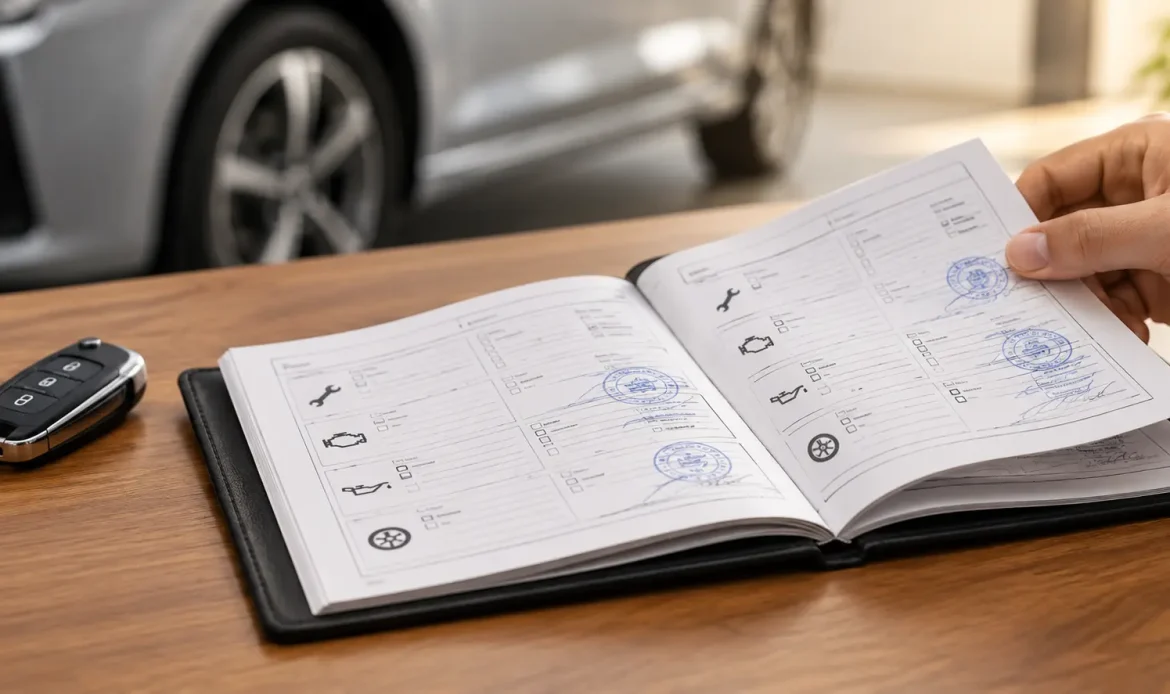
To tell if a service log book is genuine, match its vehicle identification number (VIN) to the car, then check whether each entry has a believable date, odometer reading and workshop identity. Ask for itemised invoices, contact the workshops using details you find independently, and compare recorded kilometres with any official vehicle report available. A stamp alone does not prove the work happened. Neither does a neat digital screenshot. The strongest history is a trail of records that matches the car, the servicing schedule, and what a workshop can confirm. If a seller cannot explain a gap, that does not automatically mean fraud; it means you should treat the history as unverified until you have more evidence. We can assess the car’s present condition through a pre-purchase inspection, but no inspection can certify every past service.
A used car can look excellent in photographs while its service history raises more questions than it answers. Equally, an honest owner may have lost the original booklet and kept every invoice in a folder. We see both situations. The aim is to work out what the documents actually establish before you rely on a claim such as “full service history”.
In this guide, we’ll walk through the checks in a sensible order: vehicle identity, the sequence of entries, evidence from the workshop, digital records and what to do when the story does not quite fit. You can use the same approach whether you are buying privately or through a dealer.
Start with the car, not the stamp
Before examining handwriting or logos, confirm that the book belongs to the vehicle in front of you. A genuine service record for a different car is of little use. Ask the seller to show you the VIN on the vehicle and its registration documents, then compare it with the VIN printed or written in the service booklet and on invoices.
For a modern vehicle, the VIN is a 17-character identifier. You may find it through the windscreen or on a vehicle label, depending on the model. Read it from the car itself rather than copying it only from an advertisement. Service Victoria explains what its registration check can show, including VIN and vehicle details. Use that information to look for mismatches in make, year or identity.
One transposed character could be a clerical mistake. Several documents showing a different VIN need an explanation and direct confirmation. A registration plate is less reliable for this purpose because plates can change during a car’s life.
Read the entries as a timeline
Once the identity matches, read the service history from first entry to last. The dates and odometer readings should follow a plausible sequence. A car can travel very little during one year and much more during the next, so variation alone is not proof of a false record. What matters is whether the pattern can be explained.
Use this table to separate a question from a conclusion:
| What you notice | Possible innocent explanation | What to check next |
|---|---|---|
| Odometer reading falls between services | Transcription mistake or instrument replacement | Invoices, workshop record and vehicle report |
| A long gap appears | Car was parked, serviced elsewhere or records were lost | Owner’s explanation and supporting receipts |
| Several entries use the same ink | Booklet may have been completed from earlier records | Original invoices and workshop confirmation |
| Stamp details change | Workshop moved, renamed or changed ownership | Independent business details and dates |
| Every service falls exactly on a round number | Convenient rounding or entries added later | Dated invoices with actual readings |
We do not call a logbook fake because its handwriting is tidy. We also do not accept every entry because it looks official. The timeline tells us which claims need an independent source.
Ask for the invoice behind the stamp
A service stamp usually says who signed a page and when. It rarely tells you all the work performed. An itemised invoice can show the vehicle details, recorded kilometres, labour, parts, fluid specifications and any repairs the owner declined. For a major service claim, this detail matters more than a generic “service completed” mark.
Compare the invoice with the logbook entry. Do the dates and kilometres match closely? Does the VIN or registration identify this car? Was the workshop operating at that address at the time? Does the work listed make sense for the model and its schedule?
An invoice can itself be altered, so treat it as supporting evidence rather than a magic certificate. A stack of independent, consistent documents is more persuasive than one perfectly formatted sheet. If the seller has an email from the workshop, ask to see the original message and its attachment rather than a cropped screenshot.
Call the workshop using a number you find yourself
This is one of the most useful steps when you want to know how to tell if a service log book is genuine. Search for the workshop’s current contact details independently. Do not rely only on the phone number printed on a document the seller has given you. Ask whether the workshop can confirm a service against the VIN, registration, date or invoice number.
The workshop may need the owner’s permission to release details, and older records may be archived or no longer held. A refusal to disclose personal information is not a sign that the entry is false. Ask the seller to authorise the check or request the records directly. If a business has closed, the trail may end there; record that limit honestly.
Keep your question specific. “Did you service this VIN on 14 June 2023 at around 68,000 kilometres?” is easier to check than “Is this logbook real?” The person answering may be able to confirm the job without sharing another customer’s private information.
Check digital service history differently
Some cars use electronic service records, and others have a mixture of digital entries and paper invoices. A printed page or dashboard screenshot may be useful, but you should ask where the information came from. Was it produced by the manufacturer, an authorised system, an independent workshop’s database or the seller’s own spreadsheet?
Digital evidence is strongest when a workshop or manufacturer network can confirm the entries directly. Ask the seller for a full export or record showing the VIN, dates, kilometres and work completed. A phone photo showing only a “service due” message proves very little about past work.
Independent workshops can legitimately service cars. A record does not become suspect because the stamp is not from a dealership. The ACCC explains that Australian repairers can access manufacturer service and repair information through the motor vehicle information scheme. What you need to verify is the work and the vehicle identity, not the status of a familiar logo.
Look beyond the booklet for odometer evidence
Kilometres shown on a service page can be checked against other records. In Victoria, Consumer Affairs Victoria says a VicRoads Vehicle Report can include recorded odometer readings and previous roadworthy results. Compare those dates with the logbook, invoices and the current dashboard reading.
The data may be incomplete. A missing reading does not prove wrongdoing, and a single mismatch may need investigation. Still, an official record that conflicts sharply with the seller’s story is a reason to pause the purchase and ask for an explanation.
A PPSR vehicle search addresses recorded security interests and may provide stolen or written-off information through linked vehicle data. It does not validate the service logbook. We recommend using it for the questions it actually answers, alongside the service-history checks.
Does the work match the manufacturer’s schedule?
A book may contain regular stamps yet still be missing important work. Every vehicle has its own schedule, and some items depend on age as well as kilometres. A transmission service, timing-belt replacement, brake-fluid change or other model-specific task may be documented on a separate invoice rather than in the stamp box.
Start with the exact model, engine and transmission, then compare the records with the relevant maintenance schedule. If the seller says “everything is up to date”, ask which scheduled items they mean. Our logbook servicing team can help identify what the car is due for based on its specification and the records you bring.
Do not assume a missing invoice means the work was never done. Do not assume a stamp confirms every scheduled item either. Both claims need evidence. This distinction is especially useful with European vehicles where the service display may have been reset even though a separate item remains due.
What does the car itself tell us?
The vehicle may show signs consistent with its age and use, but appearance cannot authenticate a logbook. A clean engine bay can be prepared for sale. Worn pedals do not give a precise mileage. Fresh oil does not prove years of careful maintenance.
What a mechanical inspection can do is identify present faults, maintenance needs and inconsistencies that deserve follow-up. We can check for leaks, warning lights, component wear, fluid condition where practical, tyres, brakes and model-specific issues. We can also compare observed condition with a claim that certain work was done recently. Our pre-purchase inspection service in Croydon includes an odometer and service-history review alongside the mechanical assessment.
No mechanic can reconstruct every service from the car alone. We explain what we can see, what records support and what remains uncertain. That gives you a clearer basis for a purchase decision than a simple “pass” or “fail”.
What if a record looks suspicious?
Pause and ask for the missing evidence before paying on the strength of a “full history” claim. Put the specific discrepancy in writing to the seller. For example: “The book shows 92,000 kilometres in 2024, but the invoice shows 76,000 kilometres in 2025. Can you explain the difference and provide the workshop record?”
Your next steps depend on what comes back:
- A clear correction: The workshop confirms a clerical error and supplies a corrected record.
- A plausible gap: The seller can show invoices or another traceable explanation.
- No confirmation: Treat that part of the history as unverified when deciding what the car is worth to you.
- Contradictory evidence: Stop relying on the claimed history and consider whether to continue at all.
If you are dealing with a licensed trader, keep copies of the advertisement, messages and documents. The ACCC says claims about a used car’s service history must not be misleading. That is a separate issue from our mechanical assessment, but careful records help you describe the concern accurately.
A five-minute check before you travel to see the car
You can save time by asking for the right photographs before arranging a viewing. Request the booklet’s vehicle-identification page, every completed service entry and the most recent itemised invoices. Ask whether the car has a digital history and who can provide a full copy.
Then check:
- Does the VIN match across the documents?
- Do the dates and kilometres move forward sensibly?
- Are there invoices for major claimed work?
- Can you identify the workshops independently?
- Is there a period with no records that the seller should explain?
- Does the current odometer fit the story?
These questions do not replace seeing the vehicle. They help you decide whether it is worth the trip and what to ask when you arrive. If someone asks us how to tell if a service log book is genuine, this is the short checklist we suggest before a workshop review.
Bring the records and let us check the car
Knowing how to tell if a service log book is genuine gives you a better starting point when assessing a used car. Gather the booklet, invoices and any digital history, then note what you could confirm and what is still unclear. We can use those details during an inspection and explain any mechanical concerns we find.
If the car is in or near Croydon, call Arnpro Automotive on (03) 9839 8920 to discuss a pre-purchase inspection. We’re at 18 Coolstore Road, and you can also send us the vehicle details and service records you have.
Frequently asked questions
No. It is evidence of entries in a booklet. Ask for invoices and workshop confirmation when an important maintenance claim affects your decision.
Yes. A previous owner may have lost invoices, changed workshops or had work recorded digitally. The missing period still creates uncertainty, so assess it honestly.
The logo alone does not establish authenticity. A verifiable invoice and workshop record are more useful than an unverified stamp from either type of business.
Sometimes. Ask the seller for the complete record and for permission to confirm it with the workshop or manufacturer network. Access differs by vehicle and provider.
It can check the present condition and compare records with the car, but it cannot certify every historic entry. Direct confirmation from the businesses that performed the work is stronger evidence.