
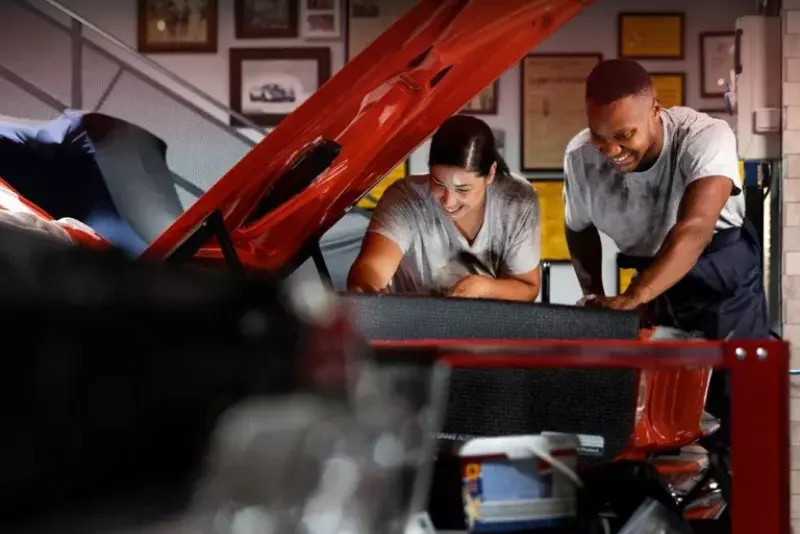
A lot of Melbourne drivers pull up to the servo, grab whatever coolant’s on the shelf, top up the overflow tank and drive off without a second thought. It’s understandable, coolant is coolant, right? Not even close. European cars are engineered to run on specific coolant formulations, and using the wrong one can be one of the most expensive mistakes you make. Using the wrong coolant, or leaving old coolant in the system too long, causes corrosion inside the engine, water pump seal failure, heater core blockage, and in serious cases, gasket failure.
Melbourne’s summer heat and long drives east through the Yarra Ranges put enormous stress on cooling systems. At Arnpro Automotive in Croydon, our team regularly sees European cars come through the workshop with coolant-related damage that was entirely preventable, damage that traces back to the wrong coolant type, or coolant that should have been changed years ago.
Here’s what every Melbourne BMW, Audi, Mercedes, and VW owner needs to know.
Why European Cars Need a Different Coolant to Your Average Car
European engines aren’t built the same way as most Japanese or Korean vehicles. Modern BMW, Audi, Mercedes-Benz, and VW powerplants make heavy use of aluminium blocks, magnesium alloy components, and specialised rubber seals. These materials react very differently to coolant chemistry than cast iron does.
That’s why European manufacturers specify exact coolant formulations, not just a generic antifreeze. There are three main technology types:
- IAT (Inorganic Additive Technology), the old-school green coolant. It uses silicate and phosphate-based corrosion inhibitors that work well in older iron-block engines but deplete quickly and can damage aluminium components. This is your conventional coolant, not suitable for modern European engines.
- OAT (Organic Acid Technology), uses organic acid corrosion inhibitors and no silicates. Much longer service life (up to 5 years in some applications), and compatible with aluminium-heavy engines. Common in VW/Audi G12 and G13 formulations.
- HOAT (Hybrid Organic Acid Technology), combines organic acids with a small amount of silicate or phosphate additives. Offers quick-acting corrosion protection alongside the longevity of OAT. Used in BMW and some Mercedes-Benz applications.
The chemistry matters because mixing incompatible types, say, adding green coolant to a G13 system, causes the inhibitor packages to react against each other. You end up with reduced corrosion protection, potential for sludging, and accelerated wear on aluminium surfaces and water pump seals.
For a deeper look at what goes into a proper European car service, see our guide to European car servicing in Croydon.
Brand-Specific Coolant Requirements for European Cars
Different manufacturers have different specifications, and this is where a lot of mistakes happen, especially with budget service centres that stock a single generic engine coolant and use it across everything.
BMW Coolant Type
BMW typically specifies a HOAT-based coolant, historically the blue G48 (G11) formula for older models, and G12++ or equivalent for more recent vehicles. Across the 3 Series, 5 Series, and X5 range, BMW’s cooling system is particularly sensitive to silicate levels. The ethylene glycol base fluid must meet BMW’s own specifications rather than a generic blue coolant off the shelf. The boiling point and freezing point performance of the correct coolant are engineered to work with the thermostat and radiator specifications in these engines. Always check your owner’s manual or ask your mechanic.
Mercedes-Benz Coolant Type
Mercedes-Benz specifies coolant meeting its MB 325.0 or 325.6 standard, typically presented as a blue or green fluid. Older models (pre-2014) used a HOAT formula, while newer ones have shifted to silicate-free OAT-based formulas. Like BMW, the correct type of coolant must match the specific model and year, not just the colour.
Audi and VW Coolant Type
This is where the most confusion happens. Audi and VW use a classification system, G11, G12, G12++, G13, that’s easy to mix up. Here’s a quick overview:
- G11, Blue/green HOAT. For older VW/Audi vehicles (pre-1997).
- G12 / G12+, Red coolant. OAT-based, no silicates. Found in many 2000s-era Audi and VW models.
- G12++, Pink/red. OAT with a small silicate additive. Backward compatible with G12 and G11 but check your spec sheet.
- G13, Purple. The newest formula, uses glycerin instead of some ethylene glycol for a lower environmental impact. OAT with silicate. Compatible with G12++ in most applications.
The most common mistake? Someone with a G13 system topping up with generic green coolant from a discount auto parts store. Green coolant contains phosphate and silicate levels that are incompatible with the organic acid technology in a G13 system. Even a partial top-up can affect the additive balance and reduce the cooling system’s corrosion resistance.
If you’re not sure what type is in your car, do not guess. The wrong coolant type can cause damage that isn’t immediately obvious but compounds over time.
Signs Your Coolant Needs Changing, Keep Your Engine Cool
Your car’s coolant doesn’t announce when it’s past its best. But there are warning signs worth knowing, especially as Melbourne summers push cooling systems harder:
- Colour change: Fresh coolant should be bright (blue, pink, purple, green depending on type). If your coolant has turned brown or rust-coloured, or you can see particles floating in the overflow tank, the corrosion inhibitors have depleted.
- Sweet smell from the engine bay: Ethylene glycol has a distinctive sweet smell. If you’re noticing it outside the car, there may be a leak, check around the radiator, hoses, and water pump.
- White deposits around the overflow tank: Residue around the coolant reservoir cap or filler neck is a sign of coolant that has been boiling or that contains contaminants.
- Temperature gauge running higher than normal: If your car runs warmer than it used to, particularly in slow Melbourne traffic or on a long run through the Yarra Ranges, the cooling system is under stress.
- Milky or creamy engine oil: This is the serious one. A milky appearance in the oil suggests coolant is entering the engine through a gasket, which needs immediate attention.
Australia’s automotive cooling systems market was valued at USD 909 million in 2024, a reflection of how much strain Australian conditions place on vehicle cooling, particularly relevant for European car owners driving in Melbourne’s heat.
Coolant Change Intervals: How Often Should You Change the Coolant in a European Car?
Coolant change intervals vary by brand and formula, but here’s a practical guide for common European makes:
- BMW: Every 4 years or 80,000 km, whichever comes first. Some later models extend this, but inspect annually.
- Mercedes-Benz: Every 3 years or as specified by model.
- Audi / VW (G13 or G12++): Up to 5 years, but inspect annually. Older G12 or G11 systems may require change intervals as frequent as every 2 years.
One issue we see constantly at Arnpro is that coolant change intervals don’t always appear on the standard service checklist used by general mechanics. If your car is serviced somewhere that doesn’t specialise in European vehicles, there’s a real chance the coolant has been overlooked for years.
According to Spherical Insights, the Australian automotive coolant market is projected to grow from 26 million litres in 2024 to over 42 million litres by 2035, reflecting a growing vehicle fleet and increasing awareness of proper coolant maintenance.
At Arnpro, we check coolant condition, including pH, colour, and corrosion inhibitor depletion, at every service. It takes minutes and can prevent thousands in engine damage. If you’re unsure of your car’s coolant history, our pre-purchase inspection service also covers cooling system condition.
What Happens If You Ignore the Coolant in Your European Car
Degraded or wrong coolant doesn’t fail catastrophically on day one. It degrades gradually, and the damage compounds:
- Corrosion in the cooling channels: As the corrosion inhibitor additive breaks down, metal surfaces are exposed. Aluminium in particular is vulnerable, and rust particles begin to circulate through the system.
- Water pump seal failure: The water pump seals and impeller degrade faster when exposed to acidic or incompatible coolant. A failed water pump means no coolant circulation, and rapid overheating.
- Radiator blockage: Corrosion debris and scale build up in the radiator, reducing flow and thermal efficiency.
- Heater core blockage: The heater core is a small, intricate component that’s expensive to access on most European vehicles. Blocked heater cores are a common result of neglected coolant.
- Gasket failure: The worst outcome. When cooling system pressure becomes inconsistent due to scale, blockage, or overheating, head gaskets can fail. This is a serious repair that can be avoided with routine coolant maintenance.
None of these repairs are cheap. Catching coolant issues early, through an annual inspection or at your regular service, costs a fraction of the alternative. For context on what our cooling system repairs involve, see that page for a full breakdown.
The Coolant Flush Process: What Actually Happens
There’s a significant difference between topping up the coolant level and a proper coolant flush. Topping up just adds new fluid to whatever’s already in the system, mixing old and new, and potentially mixing different coolant types if the wrong product is used.
A proper flush involves:
- Draining the entire cooling system completely
- Flushing the system with distilled water to remove old coolant and debris
- Refilling with the correct OEM-spec engine coolant at the right concentration (typically 50/50 with distilled water)
- Bleeding air from the system and checking for leaks under pressure
Using distilled water (not tap water) matters. Tap water contains minerals that deposit on radiator and cooling channel surfaces over time, contributing to scale build-up. European manufacturers specify distilled water for this reason.
At Arnpro, we carry OEM-specification coolants for European vehicles. When we do a coolant flush, the right coolant for your car goes back in, not whatever happened to be on the shelf.
Get the Right Coolant for Your Car, Croydon and Melbourne’s East
Your European car’s cooling system is more complex than most people realise, and coolant isn’t a one-size-fits-all product. Whether you drive a BMW 3 Series through Ringwood every day, an Audi Q5 that does the weekend run through the Yarra Ranges, or a Mercedes-Benz parked in Bayswater, the right coolant for your vehicle makes a real difference to long-term engine health.
At Arnpro Automotive in Croydon, we’ve been working on European cars for over 30 years. We check coolant condition at every service, carry OEM-spec coolants for the brands we work on, and we’ll tell you honestly whether your coolant needs a top-up or a full flush. Melbourne’s eastern suburbs, including Ringwood, Mooroolbark, Kilsyth, Bayswater, Heathmont, and Croydon, can all be easily accessed by us.
Don’t wait for a warning light to tell you there’s a problem. Book a service with Arnpro and let us check your cooling system properly.
Frequently Asked Questions: European Car Coolant
No. Different coolant types, even those that look similar, use incompatible additive packages. Mixing them reduces corrosion protection and can cause sludging in the cooling system. Always flush before switching to a different coolant type.
Check your owner’s manual or the label on the coolant reservoir cap, it often lists the specification (e.g., G13, G12++, MB 325.0). Your Arnpro mechanic can also confirm the correct spec by your vehicle’s VIN.
Tap water contains calcium and magnesium minerals that form scale deposits inside your cooling system and radiator over time. European manufacturers specify distilled water specifically to avoid this. Coolant concentrate should always be mixed 50/50 with distilled water.
Typically one to two hours, depending on the vehicle. It’s not a complex job, but it needs to be done properly, full drain, flush, correct refill, and a pressure check for leaks.
Yes. We stock OEM-specification coolants for BMW, Mercedes-Benz, Audi, and VW, and we match the correct coolant type to your vehicle before we start.