
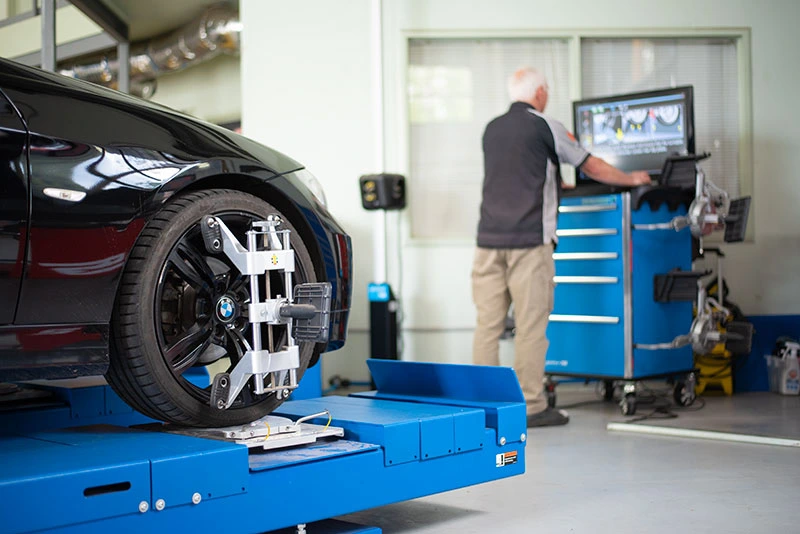
Most Melbourne drivers don’t think much about their tyre wear until something goes wrong. By then, the damage is often already done. For European vehicles, especially, the way a tyre wears is far more than a sign of age. It’s a read tyre wear diagnostic that points to something specific happening with your suspension, inflation, or alignment.
At Arnpro Automotive in Croydon, we see this every week. A BMW comes in pulling slightly to the left. An Audi develops a vibration at freeway speeds. In nearly every case, a close look at the tyre wear pattern tells us exactly what’s happening before we’ve even put the car on the lift. Understanding what your tyres are trying to tell you could save you from a much bigger repair bill down the track.
Around 33% of all vehicles surveyed nationally were found to have unevenly worn tyres and wheel alignment issues. On a European car, the consequences of ignoring this are more costly than most drivers realise.
Why Tyre Wear Matters More on European Cars
European vehicles are engineered to tighter tolerances than most Japanese or American platforms. The suspension geometry on a BMW 3 Series or Audi A4 is precisely calibrated from the factory, and even minor deviations in tyre pressure or alignment can accelerate uneven tyre wear significantly.
There’s also the cost equation to consider. Tyres on European vehicles tend to be wider, lower-profile, and more expensive to replace than standard fitments. Getting the underlying issue sorted early is nearly always far cheaper than replacing a full set of tyres prematurely.
Melbourne’s driving conditions add another layer of stress. The mix of freeway driving, stop-start suburban traffic, and rougher outer-east roads in areas like Croydon, Ringwood, and the Yarra Ranges puts constant pressure on suspension components. Add potholes and kerb impacts, and you’ve got the perfect recipe for alignment to drift and tyre wear to accelerate.
Tyre manufacturers recommend replacing tyres when the tread reaches 3mm, as below this point, braking performance reduces rapidly on wet roads. For European vehicles driven on Melbourne’s roads, keeping an eye on this is particularly important.
The 6 Key Tyre Wear Patterns and What They Mean
Learning to read tyre wear is something Arnpro’s technicians do daily. Here’s what each pattern typically points to.
- Centre Wear
What it looks like: The middle of the tread is worn significantly more than the edges.
What it means: The tyre is overinflated. When a tyre carries too much air pressure, it bows outward in the centre, reducing the contact patch on the road to a narrow strip down the middle of the tread. The edges barely touch the road surface at all.
- Common on: BMW owners who follow incorrect tyre pressure from older owner’s manual editions rather than the placard on the door jamb
- Fix: Check and adjust tyre pressure to manufacturer specifications; inspect regularly
- Edge Wear (Both Sides)
What it looks like: Both shoulder edges of the tyre are more worn than the centre wear area.
What it means: Under-inflated tyres. The tyre collapses slightly under load, pushing the contact patch out to the outer edge of the tread on both sides. The middle of the tread barely makes contact with the road.
- Common on: Any European vehicle where tyre pressure hasn’t been checked regularly
- Fix: Inflate to the correct pressure and identify whether there’s a slow leak causing the drop
- One-Side Edge Wear (Shoulder Wear)
What it looks like: The inside edge or outside edge of the tread is worn significantly more than the rest of the tyre.
What it means: Camber misalignment. Camber is the angle of the tyre relative to vertical when viewed from the front of the car. Negative camber tilts the top of the tyre inward; positive camber tilts it outward. Either way, the contact patch on the road shifts to one edge of the tyre, causing rapid shoulder wear on that side.
- Common on: BMW rear axles, which are known to develop negative camber over time as suspension components wear
- Fix: A four-wheel alignment check, and inspection of control arm bushings and wheel bearings
- Cupping or Scalloping
What it looks like: Dips or flat spots distributed unevenly around the circumference of the tyre, almost like a scalloped edge.
What it means: Worn suspension components, most commonly shock absorbers or struts. When a damper loses its ability to control wheel movement, the wheel bounces and hops across the road surface rather than maintaining consistent contact. The tread blocks hit the road harder in some spots and barely touch in others.
- Common on: Audi A6, Mercedes E-Class, and other heavier European vehicles with age
- Fix: Replace worn shocks or struts; check for worn suspension component mounts
- Feathering or Sawtooth Wear
What it looks like: The tread blocks are rounded on one side and sharp on the other, creating a sawtooth effect when you run your hand across the tread. You’ll feel it more than see it.
What it means: Toe misalignment. Toe refers to the direction the tyres point relative to the centreline of the car. Toe-out means both front tyres point slightly outward like a duck’s feet. This causes the tread to scrub sideways across the road surface with every rotation, shaving the tread blocks asymmetrically.
- Common on: VW and Skoda platforms with worn tie rod ends
- Fix: Toe adjustment as part of a full four-wheel alignment
- Diagonal or Patchy Wear
What it looks like: Wear that’s uneven both across the tread width and around the circumference, often appearing in a diagonal band across the tyre.
What it means: Usually a combination of alignment issues and wheel balance problems, sometimes compounded by irregular tyre rotation history. This kind of uneven wear is harder to diagnose from a single glance and typically requires a full inspection.
- Fix: Alignment check, wheel balance, and review of tyre rotation intervals
What Causes Alignment to Go Out on European Vehicles
On European cars, alignment drifts out for a handful of common reasons:
- Potholes and kerb impacts are the most common culprits. A single sharp impact can knock a front wheel out of alignment enough to cause noticeable uneven wear within a few thousand kilometres
- Worn control arm bushings are extremely common on higher-mileage BMWs and Audis. As the rubber degrades, the suspension geometry can shift slightly under load
- Lowered suspension or coilover setups alter camber and caster angles, often requiring custom alignment settings
- Melbourne’s outer-east roads, including sections around Croydon, Bayswater, Mitcham, and the Yarra Ranges, are particularly hard on suspension due to rough surfaces and speed humps
At Arnpro, our diagnostic process includes a visual inspection of suspension components alongside alignment measurements, so we’re not just adjusting numbers without understanding why they went out in the first place.
When to Get Your Tyres and Alignment Checked
As a general rule:
- Every 10,000 km or at each scheduled service, whichever comes first
- After any significant impact, such as hitting a deep pothole or mounting a kerb
- When your steering feels off-centre, or the car consistently pulls to one side, even on a level road
- When you notice any of the wear patterns described above
If you’re unsure what you’re looking at, Arnpro’s team can check tyre tread depth and inspect the wear pattern as part of a standard inspection. For more on what misalignment looks and feels like, read more here.
Can You Drive on Unevenly Worn Tyres?
Technically, you can. Safely, you shouldn’t.
Worn tyres with uneven wear have a reduced contact patch on the road, which means less grip, longer stopping distance in an emergency, and a higher risk of skidding on wet roads. The tyre’s tread grooves are designed to channel water away from the contact patch. When that tread wears down unevenly, the tyre’s ability to channel water away is compromised in exactly the spots where you need it most.
There are also legal implications in Victoria. A tyre that falls below the minimum legal tyre tread depth is considered unroadworthy in Victoria, and a tyre must not have excessive uneven wear across its width. If tyres wear down below 1.5mm, they are unroadworthy, illegal, and dangerous, and your car insurance won’t cover an unroadworthy vehicle.
Most tyre manufacturers and the RACV recommend thinking about tyre replacement well before you hit the legal minimum. As RACV’s Regional Manager of Automotive Services notes, the difference between a safe stop and a serious collision can come down to just a few millimetres of tyre tread.
To check if your tyres are approaching the limit, use a tread depth gauge or look for the tread wear indicators moulded into the tread grooves. These are small raised bars sitting across the tread grooves at 1.6mm. If your tread doesn’t reach above these indicators, it’s time to replace your tyres immediately.
At Arnpro, we check tyre tread depth, assess the tread depth for uneven wear patterns, and flag any legal tyre concerns as part of our standard service inspection.
Getting It Diagnosed in Croydon
If you’ve spotted any of the patterns above on your European car, the best next step is a professional inspection rather than guessing. At Arnpro Automotive in Croydon, we combine a visual tyre assessment with a full alignment check and suspension inspection. We check tyre wear alongside suspension condition because the two are almost always connected.
We regularly see drivers from Croydon, Ringwood, Mitcham, Bayswater, Wantirna, and across Melbourne’s eastern suburbs. If your maintenance schedule is due or if something feels off with your steering, bring it in, and we’ll tell you exactly what’s happening.
Book a Tyre Inspection at Arnpro in Croydon
If your European car’s tyres are showing any of the wear patterns above, don’t wait until it turns into a suspension repair or a roadside problem. The team at Arnpro Automotive in Croydon reads tyre wear every day and can quickly diagnose what’s behind it and what needs to be fixed. Book in online or call us to arrange an inspection at our Croydon workshop.
Frequently Asked Questions
It usually points to negative camber, where the top of the tyre tilts inward. This shifts the contact patch to the inside edge, causing faster wear there. It’s common on rear axles of BMW models and needs a wheel alignment inspection.
Tyre rotation every 10,000 km is a sensible baseline, though your owner’s manual may specify differently. Regular rotation helps promote even wear and extends tyre life, particularly on front-wheel-drive and all-wheel-drive European vehicles where front tyres wear faster.
Yes. Persistent misalignment puts abnormal stress on worn suspension components like control arm bushings, ball joints, and tie rod ends, accelerating wear and leading to bigger repair jobs over time.
BMW’s often run with slightly more negative camber than other vehicles, especially at the rear. Combined with the performance-oriented rubber compounds typically fitted from the factory, this can result in a higher wear rate than you might be used to with Japanese cars.
On most European vehicles, especially all-wheel-drive models, fitting mismatched new tyres alongside significantly worn tyres can cause stress on the drivetrain. At minimum, replace tyres in axle pairs, and always check whether your vehicle’s manufacturer recommends a full set.