
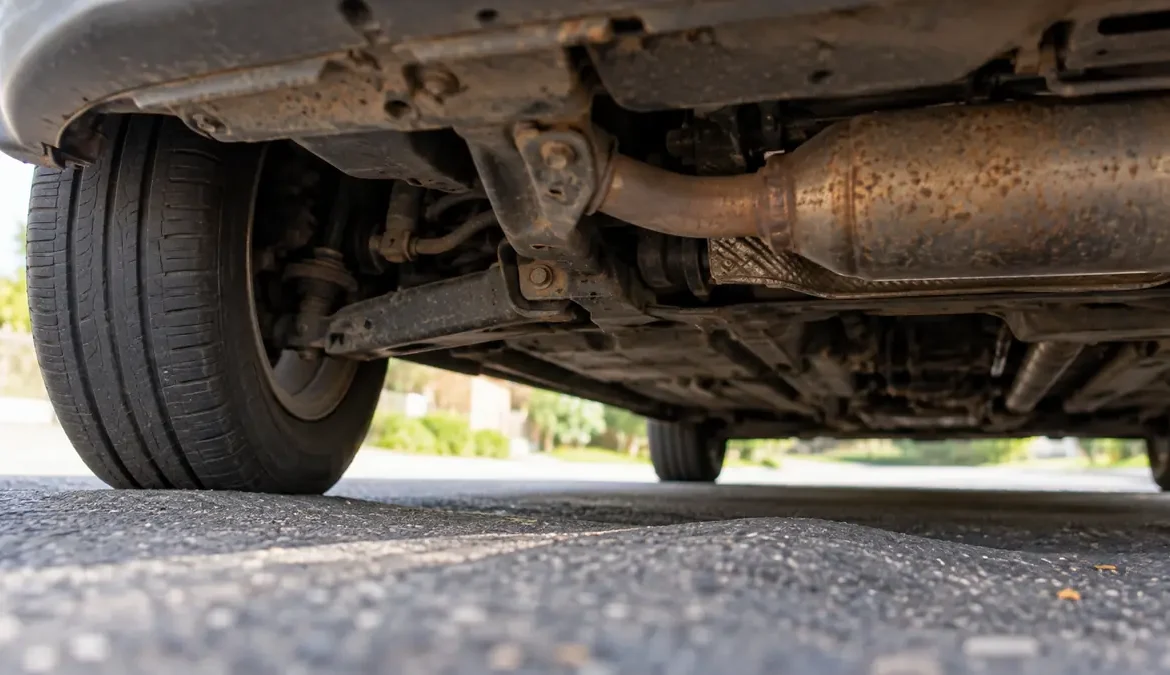
A knocking noise over bumps usually means a suspension, steering or mounted component is moving farther than intended. Common sources include worn anti-roll-bar links or bushes, control-arm bushes, strut top mounts, ball joints, shock absorbers, loose undertrays, exhaust mounts and, less often, steering-rack or subframe movement. The type of bump, which corner makes the noise, and whether braking or steering changes it help narrow the cause. Remove loose items from the boot before assuming the suspension is faulty, but do not crawl under an unsupported vehicle or keep driving if steering feels loose, the car pulls sharply, a wheel changes position, or the knock follows a hard impact. A raised inspection and controlled road test are usually needed because several worn parts can sound almost identical from the driver’s seat.
A knocking noise over bumps rarely introduces itself by part name. It may sound like a dull thud over a speed hump, a light rattle on broken road, or a sharp clunk as you turn into a driveway.
We use the pattern of the noise to decide what to inspect first. This guide walks you through those patterns, explains the likely groups of parts, and shows where a simple observation ends and a workshop inspection should begin.
First, make sure the noise is not inside the car
Before looking for a failed suspension part, remove obvious loose items. A spare wheel, jack, parcel shelf, child-seat fitting, tool or bottle in a door pocket can imitate a chassis knock.
Check these without dismantling the vehicle:
- empty loose items from the boot and footwells;
- confirm the spare wheel and tools are secured;
- check that seats latch correctly;
- note whether the noise occurs with windows open or closed; and
- listen for whether it comes from the front, rear or centre.
If the sound remains, do not bounce or rock the car while someone lies underneath. A vehicle must be correctly lifted and supported before an underbody inspection.
What does the type of knock tell us?
Noise descriptions are imperfect, but the situation can still guide the inspection.
| Noise pattern | Components commonly considered |
| Light rattle over repeated small bumps | Anti-roll-bar links, bushes, heat shield or undertray |
| Single clunk entering a driveway | Control-arm bush, ball joint, top mount or movement in a mounted component |
| Knock while steering at low speed | Top mount, steering joint, ball joint or spring movement |
| Clunk when braking or accelerating | Control-arm bush, subframe mount, engine or transmission mount |
| Rear thud over larger bumps | Shock mount, trailing-arm bush, exhaust or boot equipment |
| Knock after pothole or kerb impact | Wheel, tyre, spring, arm, joint or alignment damage |
The same component can make different sounds as wear develops. More than one worn part can also be present, particularly on an older vehicle.
Anti-roll-bar links and bushes
The anti-roll bar connects left and right suspension movement to reduce body roll. Short links and rubber mounting bushes allow it to move in a controlled way.
Wear often produces a light knocking or rattling on small alternating bumps, where one wheel moves before the other. The car may still feel reasonably normal on a smooth road.
We inspect the link joints, bush condition and mounting points. Replacing a link because it is common without checking the surrounding parts can leave the original noise untouched.
Control-arm bushes
Control arms locate the wheel as the suspension moves. Rubber or hydraulic bushes isolate vibration while controlling fore-and-aft and sideways movement.
When a bush tears or separates, the arm can shift under braking, acceleration or a bump. You may notice:
- a deeper clunk rather than a light rattle;
- vague steering or tramlining;
- movement when braking;
- uneven tyre wear; or
- a wheel that does not hold alignment.
Some European vehicles use fluid-filled bushes. A visible leak or separation can help confirm failure, but the bush also needs to be assessed under appropriate load.
Ball joints and steering joints
Ball joints allow suspension movement while holding the wheel in position. Tie-rod ends transfer steering input. Wear in either area can create a knock and looseness.
This category matters because severe wear can affect control of the wheel. Warning signs include changing steering response, uneven tyre wear, wandering, a clunk while steering and detectable play during inspection.
The Victorian roadworthiness requirements include steering and suspension because these systems affect safe vehicle control. A roadworthy certificate is not a substitute for routine fault diagnosis, but looseness in a safety-critical joint cannot simply be ignored.
Strut top mounts and bearings
A MacPherson strut commonly attaches to the body through a top mount. On the front axle, the assembly may also include a bearing that turns as you steer.
A worn mount can knock over bumps, while a binding bearing may creak, catch or allow the spring to release with a sudden sound during steering. The noise can seem to come from the dashboard or inner guard because the mount attaches high in the body.
Inspection may involve observing the mount while steering and checking the strut assembly when raised. Spring tension makes strut work hazardous without the correct equipment.
Shock absorbers and struts
A shock absorber controls spring movement. When its internal damping weakens, the car may continue bouncing after a bump, feel unsettled through corners or take longer to regain control.
A knock can come from an internal fault, a worn mounting bush or a loose attachment. Oil visible on the damper may support the diagnosis, but a light film is not interpreted the same way as active leakage.
Transport Victoria’s safety information reminds drivers that vehicle maintenance affects safe operation. Dampers deserve attention because their job includes keeping the tyre controlled against the road, not merely improving comfort.
Broken or displaced springs
A coil spring supports the vehicle’s weight. A broken end can alter ride height, make a metallic noise and damage a tyre if the spring moves out of position.
Look from outside for one corner sitting lower, but do not put your hand into the spring or wheel area. Springs store energy and must be handled with proper equipment.
Rust, impact and repeated load can contribute to failure. The matching spring and related seat or isolator should be checked, not only the visibly broken piece.
Loose undertrays, heat shields and exhaust mounts
Not every knock is suspension wear. A plastic undertray may lose a fastener, an exhaust hanger may stretch, or a heat shield may rattle against another part.
These noises often change with engine speed, wind or body movement. A loose exhaust may thud when the car rocks during acceleration or passes over a larger bump.
The repair can be simple, but the inspection still matters. A loose panel can detach, and an exhaust that moves too far can stress joints or contact heat-sensitive areas.
Could the engine mount be the cause?
An engine or transmission mount can produce a clunk when torque changes, particularly as you select a gear, accelerate or lift off. It may also allow vibration at idle.
That pattern differs from a noise created only by small road bumps, although worn components can overlap. Our guide to failing engine mount signs explains the load-related clues in more detail.
We check mounts for actual movement and deterioration. A vibration does not prove a mount has failed, and a visually aged mount does not prove it is the source of the knock.
When should you stop driving?
Arrange towing or immediate advice if:
- steering suddenly feels loose or unpredictable;
- a wheel appears out of position;
- the vehicle sits much lower at one corner;
- a spring or suspension part is visibly broken;
- the noise followed a major pothole, kerb strike or collision;
- a tyre is rubbing on the body or suspension;
- the car pulls sharply or cannot hold a straight line; or
- the knock becomes a heavy repeated impact.
A mild, stable rattle may allow a careful trip to the workshop, but call (03) 9839 8920 if you are not sure. Describe what happened and how the car feels, not only the sound.
What should you record before the inspection?
A short set of observations can save time:
1. Is the noise front or rear, left or right?
2. Does it occur on small ripples, large bumps or both?
3. Does steering, braking or acceleration change it?
4. Is it worse when the car is cold, loaded or wet?
5. Did it begin after tyre, brake or suspension work?
6. Was there a pothole or kerb impact?
7. Has tyre wear or steering position changed?
A passenger can help locate the general area, but the driver should keep attention on the road. Do not repeatedly hit a bump to reproduce a severe noise.
How we diagnose suspension knocking
We start with a controlled road test where the vehicle is safe to drive. The goal is to reproduce the sound and learn which body movement triggers it.
The raised inspection may then include:
- Tyres and wheels
- Anti-roll-bar links and bushes
- Control arms and bushes
- Ball joints and tie-rod ends
- Struts, shocks, springs and top mounts
- Wheel bearings
- Subframe and mounting points
- Undertrays, shields and exhaust mounts
- Engine and transmission mounts where the pattern fits
Components need to be tested in the direction they normally carry load. A quick visual glance can miss movement that appears only when the joint is loaded.
Our European car repair and maintenance service includes suspension work and wheel alignment. We explain which item is creating the noise and whether related wear needs attention now or can be monitored.
Why alignment comes after worn parts are repaired
Wheel alignment sets the relationship between the wheels and vehicle. It cannot hold a setting when a bush, joint or arm is loose.
The correct order is:
1. inspect tyres, wheels, steering and suspension;
2. repair any component that prevents accurate adjustment;
3. check ride height and relevant specifications; and
4. perform alignment where required.
This avoids paying for an alignment that immediately changes again. It also protects new tyres from the wear pattern created by the original fault.
Can a scan tool find a suspension knock?
Not usually by itself. Mechanical looseness is found through inspection and testing. However, electronically controlled dampers, air suspension, ride-height sensors and steering systems can store useful fault information.
On an equipped European vehicle, our diagnostic and fault-finding service may be used alongside the mechanical inspection. The scan shows what the control system has observed; the physical checks show what is moving.
Will a suspension knock fail a roadworthy certificate?
The noise itself is not the final decision. The inspector assesses the condition and security of steering and suspension components against Victorian requirements. Excessive wear, looseness, damage or insecure mounting can affect roadworthiness.
If you are preparing a vehicle for sale, arrange assessment before the certificate deadline becomes urgent. Our explanation of what can fail a Victorian roadworthy helps you understand the broader inspection without promising that a pre-check guarantees a pass.
Book a suspension inspection in Croydon
A knocking noise over bumps can come from a modest link or a safety-critical joint. The sound alone cannot make that distinction.
Arnpro Automotive is a family-owned European specialist at 18 Coolstore Road, Croydon, with more than 30 years of experience. Call (03) 9839 8920 to book a suspension inspection. Tell us where you hear the noise and which road movement triggers it, and we will test the cause before recommending repair.
Frequently asked questions
No. A loose shield can make an alarming noise without affecting wheel control. A worn ball joint may be far more serious. Inspection establishes which situation applies.
Small alternating movements commonly reveal anti-roll-bar link or bush wear, but mounts, shields and other joints can sound similar.
Alignment changes geometry; it does not repair looseness. Worn or damaged parts must be addressed before alignment can remain accurate.
A fastener, mounting position, neighbouring worn part or settling component may need checking. Return promptly and describe exactly when the noise began.
It depends on the component, vehicle, wear, and the manufacturer’s procedure. Dampers and springs are commonly considered across an axle, while an individual joint may be handled differently. We advise after inspection.