
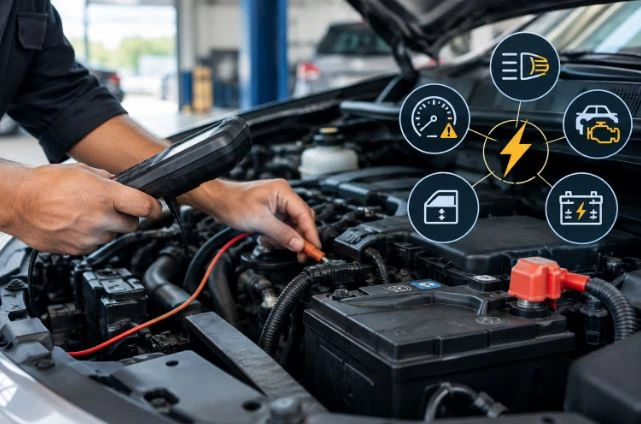
Auto electrical fault symptoms can look like a failing battery even when the battery is not the root cause. Slow starting, dim lights, warning messages and repeated flat batteries may also involve the charging system, starter circuit, wiring, poor connections, a control module or an electrical drain while the car is parked.
The useful next step is testing, not replacing parts by guesswork. If a battery is discharged, a technician still needs to ask why. A correct diagnosis separates a worn battery from a healthy battery being drained or left undercharged by another fault.
Why so many faults get blamed on the battery
The battery is visible, familiar and relatively easy to test. Low voltage can also cause several systems to complain at once, especially in a modern vehicle with many electronic control units.
That does not mean every warning is a separate failure. It also does not mean replacing the battery will solve the cause. A weak supply can be the problem, the result of a charging fault, or simply a consequence of the vehicle sitting unused.
Good diagnostic and fault finding in Croydon begins with the symptom, operating conditions and recent history. Test results then narrow the possibilities before parts are authorised.
The battery keeps going flat
A repeated flat battery is one of the clearest reasons to look beyond the battery itself. Possible causes include insufficient charging, a poor connection, a light or accessory remaining active, a control unit failing to enter sleep mode, or driving patterns that do not restore the energy used during starting.
Age and condition still matter. A worn battery may accept a surface charge and then lose capacity quickly. The technician can assess its state while also measuring charging behaviour and current draw.
Tell the workshop how long the car sits, whether the fault follows rain or accessory use, and how recently the battery was replaced. Dash cameras, trackers, audio equipment and other additions should be mentioned because installation and settings can affect standby draw.
Do not repeatedly jump-start a vehicle without finding the cause. Incorrect connections can damage equipment, and a car that stops after starting may leave you stranded in traffic.
The engine cranks slowly or only clicks
A slow crank can reflect low battery charge, but resistance in cables or connections can produce a similar result. A click with no crank may involve the battery, terminals, starter relay, solenoid, starter motor, wiring or control conditions that prevent operation.
Observe whether the symptom changes when the engine is hot, the weather is cold, or the vehicle has been parked overnight. Intermittent heat-related starter faults can behave differently from a battery that is consistently weak.
Lights remaining bright does not rule out a starting-circuit problem. Cranking requires far more current than many accessories. Voltage-drop testing under load can reveal resistance that a visual check misses.
The battery warning light appears while driving
The battery-shaped warning commonly relates to the charging system, not simply to battery age. If it appears while driving, the vehicle may be operating on stored battery energy because the alternator or charging circuit is not supplying correctly.
The safe response depends on the vehicle and circumstances. Reduce non-essential electrical load where safe, avoid assuming you can complete a long journey, and arrange assistance. Steering, cooling or other systems may be affected on some vehicles if a drive belt has failed.
A technician may check output, control signals, wiring, connections and belt condition. Modern charging systems can vary output by design, so one voltage reading without vehicle-specific context may be misleading.
Lights change brightness with engine speed
Headlights or interior lights that pulse, dim or become unusually bright can point to unstable system voltage, poor grounds, a charging issue or a connection fault. The pattern matters.
Note whether it occurs at idle, when accessories switch on, over bumps or only during wet weather. A fault that reacts to movement can suggest a loose connection or damaged wiring, while a change tied to electrical load may direct testing elsewhere.
Do not fit higher-output globes or alter lighting circuits to hide the symptom. That can add load and complicate diagnosis. Check the supply and circuit first.
Several unrelated warning messages appear together
Modern vehicles exchange information across networks. Low or unstable voltage can cause several modules to record faults or briefly lose communication. One supply problem may therefore create a dashboard full of warnings.
Scanning the vehicle is useful, but every stored code does not necessarily represent a failed component. A technician considers when codes were recorded, their status and whether they return after the electrical supply is stabilised.
This is particularly relevant to European vehicles, where battery replacement may require registration or adaptation and control systems can be sensitive to supply condition. Arnpro services European makes from its Croydon workshop and can combine electrical testing with model-specific diagnostic information.
Accessories work intermittently
Windows, locks, wipers, seats, infotainment or climate controls that operate only sometimes may have a local switch or motor fault, damaged wiring, a poor connector, a control-module issue or a wider supply problem.
Intermittent faults are easier to diagnose when the workshop can reproduce them. Record a short video if it is safe, note the temperature and weather, and write down which other systems were in use. Avoid dismantling trim or disturbing wiring before inspection because the fault may disappear temporarily.
If water entered the cabin or a repair occurred nearby, mention it. Moisture and previous work can provide important context without proving the cause.
Fuses keep blowing
A fuse protects a circuit by opening when current exceeds its rating. Replacing it with a larger fuse is dangerous because the wiring may then overheat before the fuse opens.
If the correct replacement blows again, stop and have the circuit diagnosed. Shorted wiring, a failing component, moisture or an incorrectly installed accessory may be involved.
Tell the technician exactly when it blows. Switching on a particular function, moving the steering, opening a door or travelling over a bump can help isolate the circuit and location.
There is a burning smell or hot electrical connection
A hot-plastic smell, smoke, visible melting or a very hot cable needs prompt attention. Switch the vehicle off when safe and seek assistance. Do not continue testing the function to see whether the smell returns.
Electrical resistance and short circuits can generate heat. Aftermarket accessories, damaged connectors and loose high-current connections are among the areas a technician may examine.
If there is smoke or fire, prioritise personal safety and contact emergency services where required. This article cannot assess an immediate hazard remotely.
The car starts after a jump but stops again
A jump start supplies energy for cranking. If the car soon stops, the charging system may not be maintaining electrical supply, although other faults can also cause stalling.
Do not assume another jump will make the vehicle suitable to drive. Testing should consider the battery, alternator or charging unit, belt drive, connections and vehicle-specific controls.
If the engine runs but steering becomes heavy, temperature rises or warning lights multiply, stop safely and arrange assistance. A shared drive belt problem can affect more than charging on some vehicles.
The fault began after a battery replacement
New does not always mean correct. The battery may be the wrong type or capacity, incompletely charged, poorly connected or not registered to the vehicle where that procedure applies.
The replacement can also expose an existing issue. A vehicle with a charging fault may flatten the new battery just as it flattened the old one. A memory or calibration issue after power was disconnected can create different symptoms.
Bring the battery invoice and specification to the workshop. Explain whether the problem existed before replacement and what changed afterwards.
What auto electrical fault finding involves
Diagnosis usually begins with questions and a visual inspection. The technician may then test battery condition, charging performance, voltage drop, circuit operation and current draw. A diagnostic scan can add information from control units.
The sequence depends on the symptom. Testing every circuit indiscriminately wastes time. A good description helps narrow the search, while wiring diagrams and model information help locate connectors, modules and expected values.
Some intermittent faults require the vehicle to sit, reach a temperature or be driven under certain conditions. Ask how diagnostic time will be authorised and when the workshop will contact you with findings.
What a fault code can and cannot tell you
A diagnostic trouble code records that a system observed a value or condition outside its expected range. It does not always name the failed part.
For example, a code involving a component may be caused by its power supply, ground, wiring, connector, another sensor or the mechanical system it monitors. Replacing the named component without tests can leave the original symptom unchanged.
Ask the workshop to explain the evidence linking the proposed repair to the fault. That explanation need not be highly technical. It should identify what was tested, what was found and why the repair follows.
Information to collect before the booking
Write down:
1. The exact symptom and warning message
2. Whether the engine was cold or warm
3. How long the vehicle had been parked
4. Weather or moisture conditions
5. Which accessories were operating
6. Recent battery, audio, camera or repair work
7. Whether a jump start changed the symptom
8. How often the fault occurs
Photos and videos can help where safe. Do not use a phone while driving. Ask a passenger to record the event or document it after stopping.
Is the vehicle safe to drive?
That cannot be decided from a symptom list alone. A charging warning, burning smell, smoke, loss of essential lights, repeated stalling, or faults affecting steering, braking or other safety systems warrant caution and may require roadside assistance.
For a minor intermittent convenience feature, the immediate risk may be different, but the fault should still be assessed before it spreads or leaves the vehicle unusable.
If unsure, stop in a safe place and seek professional advice. Do not continue driving solely to reproduce a dangerous symptom.
For breakdown preparation, VicRoads provides guidance on what to do when a vehicle breaks down. If there is smoke, fire, a collision risk or another immediate danger, move away from traffic where possible and contact the appropriate emergency service.
Electrical symptoms that appear after a component replacement may also relate to a product recall rather than ordinary wear. The Australian Government’s vehicle recalls database lets owners check published recalls, although it does not diagnose the fault in a particular vehicle.
Book auto electrical fault finding in Croydon
If you recognise these auto electrical fault symptoms, resist the temptation to fit another part without testing. Bring the vehicle history and your notes to a diagnostic appointment.
Arnpro Automotive is at 18 Coolstore Road, Croydon and provides diagnostic, repair and auto electrical work, with particular experience in European vehicles. Book diagnostic and fault finding or call 03 9839 8920.
Frequently asked questions
Yes. It may be undercharged, unsuitable, faulty or drained by another problem. The charging system and standby current may need testing.
Not necessarily. It commonly indicates a charging-system problem. Arrange assessment promptly.
No. It provides valuable system information, but wiring, connections, supply and component operation may require separate tests.
Temperature, vibration, moisture, time parked, and electrical load can make intermittent faults difficult to reproduce. Detailed notes or a safe video can help.
It can contribute if its wiring, parking mode or power management is unsuitable, but testing is needed before blaming the accessory.